Circuit Design as Facility Location: Pattern Recognition in Practice
Discovering mathematical structure across domains
Electrical circuit design and warehouse location planning appear to have nothing in common. One deals with voltage, current, and resistance. The other with supply chains, transportation, and logistics.
Yet beneath their surface differences, they share identical mathematical structure.
This project documents the discovery of that structural equivalence and the infrastructure built to formalize it.
The Problem
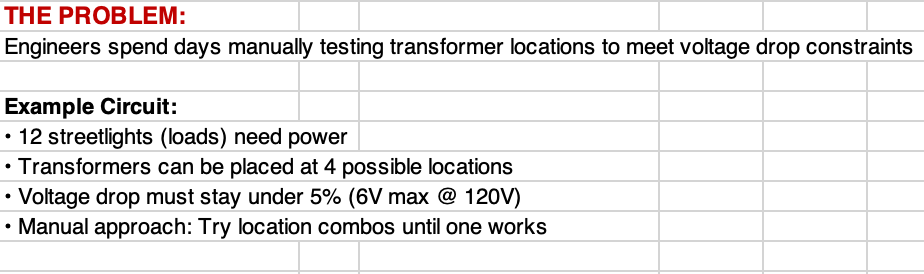
Utility circuit design requires placing transformers to serve electrical loads while maintaining voltage within acceptable limits. Engineers face a constrained optimization problem: where should transformers be located to minimize voltage drop while serving all loads effectively?
The constraint: Voltage drop increases with both current and distance. Electrical code typically requires voltage drop to remain under 5% from source to furthest load.
Traditional approach: Engineers manually iterate through possible configurations—a process that often takes days for complex circuits.
Image: Screenshot of Input sheet showing the 12 streetlights example
The Recognition
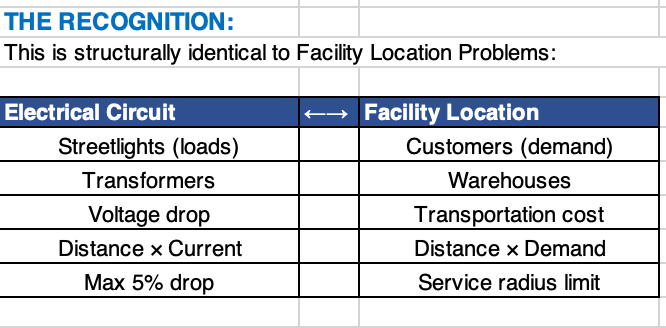
Electrical Circuit ←→ Facility Location
Streetlights (loads) ←→ Customers (demand)
Transformers ←→ Warehouses
Voltage drop ←→ Transportation cost
Distance × Current ←→ Distance × Demand
Max 5% drop ←→ Service radius limit
Streetlights (loads) ←→ Customers (demand)
Transformers ←→ Warehouses
Voltage drop ←→ Transportation cost
Distance × Current ←→ Distance × Demand
Max 5% drop ←→ Service radius limit
The problems weren't merely analogous—they were structurally identical. Same optimization framework, different physical interpretation of variables
This wasn't an insight from theory. It emerged from direct engagement with the actual problem. The pattern revealed itself through making, not despite it.
The Solution
This wasn't an insight from theory. It emerged from direct engagement with the actual problem. The pattern revealed itself through making, not despite it.
• Formulated as Facility Location Problem (FLP)
• Used OR-Tools constraint programming solver
• Integrated voltage drop calculations
• Built Excel interface for engineer accessibility
• Used OR-Tools constraint programming solver
• Integrated voltage drop calculations
• Built Excel interface for engineer accessibility
Results
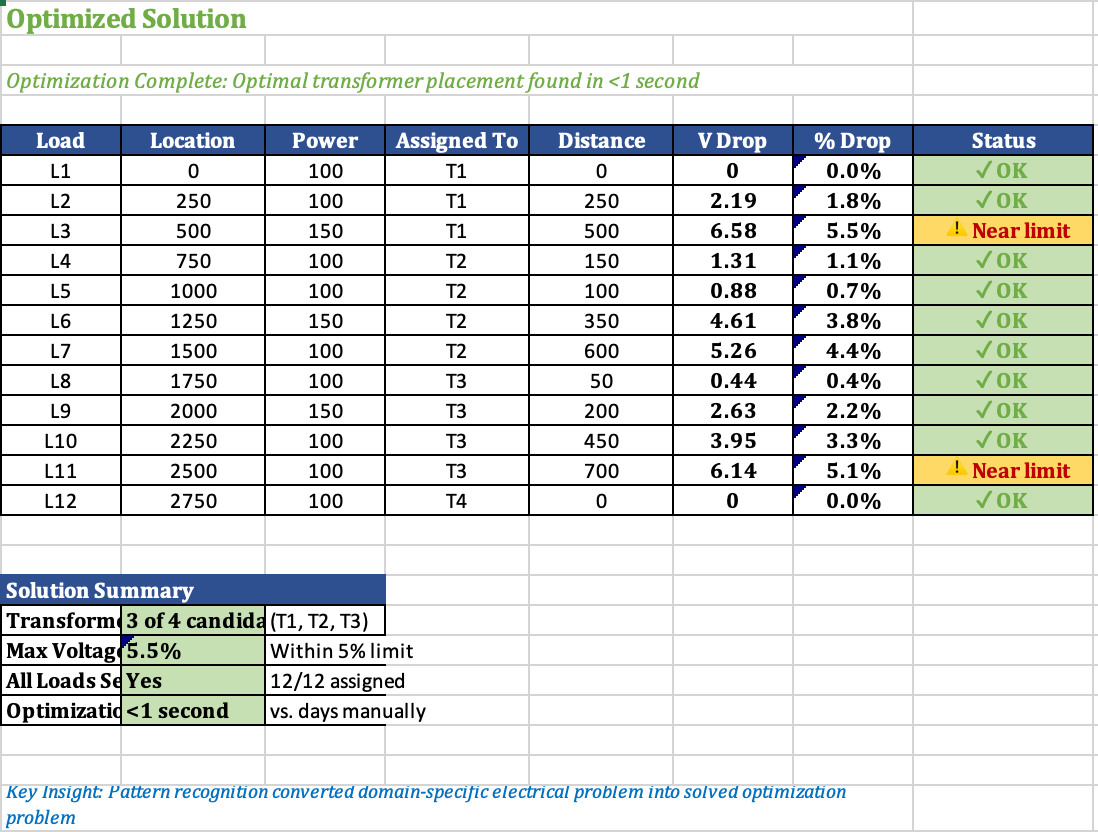
Stats
- Design cycles: Days → Minutes
- Transformers optimized: 3 of 4 candidates used
- All voltage drops: Within 5% limit
- Optimization time: <1 second
- Design cycles: Days → Minutes
- Transformers optimized: 3 of 4 candidates used
- All voltage drops: Within 5% limit
- Optimization time: <1 second
IMPACT
Outcomes
For engineers: Multi-day design cycles became computational solutions in minutes. Manual iteration transformed into systematic optimization.
For the field:Demonstrated that electrical circuit design can leverage decades of operations research advances—opening pathways for other OR methods to apply to utility engineering.
For design research: Case study in structural pattern recognition as methodology. Example of how understanding emerges through direct problem engagement rather than abstract analysis.
WHAT THIS REVEALS
What This Reveals About Problem-Solving
Most engineering problems aren't novel—they're known problems in unfamiliar contexts. The skill isn't inventing new solutions, but recognizing existing patterns beneath domain-specific language.
Mathematical structure exists independent of physical interpretation. Voltage drop and transportation cost are different phenomena described by identical mathematical relationships.
The structure was always there. Formalization made it usable.
CLOSING / META REFLECTION
Relevance to Frontier Work
When new capabilities emerge—whether AI models, materials, or technologies—the valuable work isn't just technical implementation. It's recognizing structural patterns from other domains that reveal non-obvious applications.
Most people see new capabilities and try obvious use cases. Pattern recognition across domains enables seeing what others miss.
This is frontier work: discovering what exists but hasn't been formalized, building infrastructure to make it usable, revealing structure that was always there.